New Delhi: Water is one of the most critical natural resources, supporting ecosystems, livelihoods, and economic development. It plays a central role in agriculture, industry, energy generation, and overall human well-being. As societies continue to rely on water for multiple purposes, the need for efficient and coordinated use of water has become increasingly important.
River Basin Management (RBM) is a comprehensive scheme for the management, protection, improvement, and sustainable use of water resources across river basins. These resources include rivers, lakes, streams, groundwater, and associated ecosystems. The approach emphasizes integrated planning and development of water resources to ensure optimal utilization. In India, where river systems are complex and interlinked, basin-level planning has become essential for addressing challenges such as floods, erosion, uneven water distribution, and ecological degradation. Recognizing these challenges, the River Basin Management (RBM) Scheme is being implemented in a structured and scientific manner.
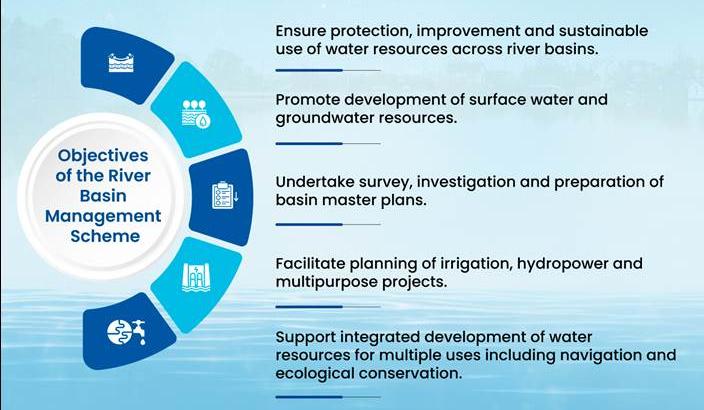
RBM is a central sector scheme of the Department of Water Resources, River Development, and Ganga Rejuvenation under the Ministry of Jal Shakti. The scheme aims to facilitate integrated planning, investigation, and development of water resources at the river basin level, including both surface water and groundwater systems. It is implemented through three key organisations—namely, the Brahmaputra Board, the Central Water Commission (CWC), and the National Water Development Agency (NWDA)—and supports activities such as the preparation of basin master plans, the survey and investigation of projects, and the planning of multipurpose projects.
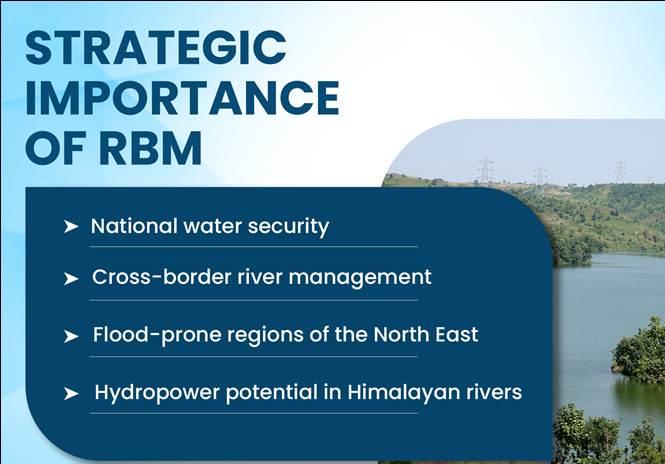
The RBM Scheme primarily focuses on strategically important and water-rich but underdeveloped regions, particularly: North Eastern Region river basins, Indus Basin in Jammu & Kashmir / Ladakh.
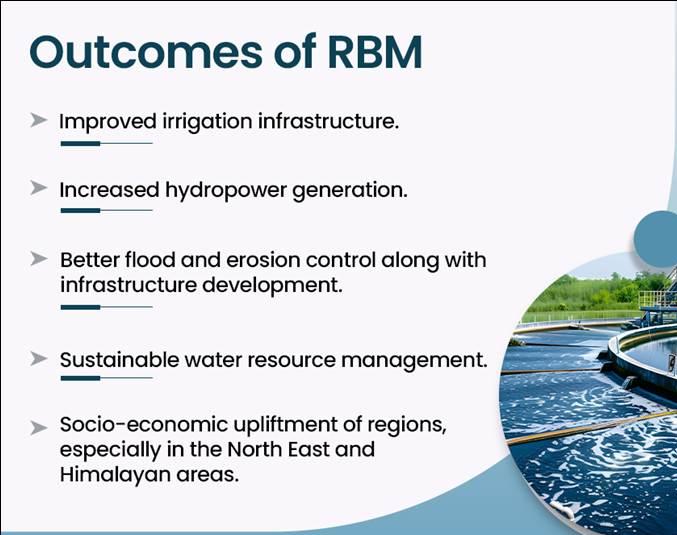
Key basins are Brahmaputra, Barak, Teesta, and Indus. These basins are prioritised due to their importance in: –
1) National water security.
2) Cross-border water management.
3) Flood control and erosion management.
4) Ecological stability.
The scheme also addresses capacity gaps in states such as Jammu & Kashmir, Sikkim, Mizoram, Manipur, and Nagaland, which require central support for project planning and development. The RBM Scheme is proposed to be continued during the 16th Finance Commission period from 2026–27 to 2030–31 with a fully funded estimated financial outlay of ₹2183 crore. In the previous phase, covering 2021–22 to 2025–26, the total budget allocation for the scheme was ₹1276 crore. This reflects a continued and increased commitment toward integrated water resource planning and development.
The River Basin Management framework represents an important step toward strengthening India’s capacity to manage its river systems in a coordinated and forward-looking manner. By promoting scientific assessments, infrastructure readiness, and institutional collaboration, the initiative has laid the groundwork for more resilient water systems across strategically important regions. Its continued implementation will play a vital role in addressing emerging challenges such as climate variability, population growth, and increasing demand for water across sectors. At the same time, sustained technical support and targeted investments will help vulnerable and remote regions build stronger systems for flood protection, water storage, and resource utilization. In the long run, the success of River Basin Management will depend not only on physical infrastructure but also on sustained coordination among institutions, adoption of modern technologies, and community participation. Together, these efforts contribute to improved water security, greater regional stability, and more balanced socio-economic growth across the country.