

Management Consultant & AI Strategist
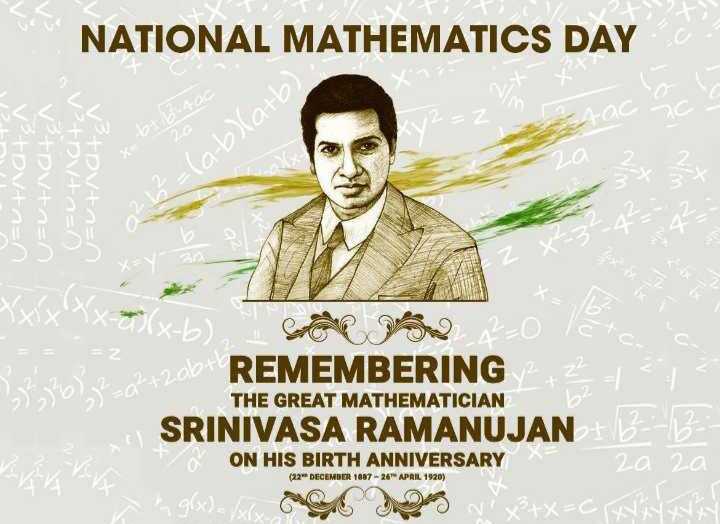
Every year on December 22, India observes National Mathematics Day to commemorate the birth anniversary of Srinivasa Ramanujan, a genius whose work transformed mathematical thought across the world. More than a remembrance of past brilliance, this day offers an opportunity to reflect on how mathematics education itself is evolving in a rapidly changing world. In 2025, that reflection is especially timely.
Ramanujan’s approach to mathematics was deeply intuitive, creative, and fearless. He did not see mathematics as mechanical calculation, but as a living language of patterns and ideas. Interestingly, this philosophy aligns closely with the new face of mathematics education emerging in India today under the National Education Policy (NEP) 2020.
Traditionally, mathematics learning focused heavily on memorisation, speed, and examination performance. The new paradigm shifts the emphasis toward conceptual clarity, logical reasoning, and real-world application. Mathematics is now seen as a foundational tool for developing critical thinking rather than merely a subject to score marks in. Competency- based assessments, experiential learning, and interdisciplinary connections are helping students understand the “why” behind the formulas, not just the “how”.
Launching DHRUV64 is the Milestone of India’s Semiconductor Journey
The NEP also promotes flexibility and inclusivity, allowing learners to engage with mathematics at different levels and through diverse contexts—whether in science, commerce, economics, technology or social sciences. This reflects a global movement toward aligning education with real-life problem-solving and employability.
A key force accelerating this transformation is Artificial Intelligence (AI). In mathematics education, AI is proving to be a powerful enabler rather than a replacement for teachers. Intelligent learning platforms can identify individual learning gaps, adapt question difficulty, and provide instant feedback. For students who struggle with mathematics, this personalised support can build confidence and reduce anxiety. For advanced learners, AI enables deeper exploration and enrichment.
More importantly, AI shifts the focus away from repetitive calculations toward higher-order thinking. With technology assisting routine computation, classrooms can prioritise reasoning, pattern recognition, modelling, and application—skills that Ramanujan himself embodied. AI also enables data- driven insights for teachers, helping them design more effective and inclusive learning experiences.
In today’s interconnected world, mathematics has become a universal skill. It underpins data science, artificial intelligence, finance, climate research, behavioural studies, and countless emerging fields. Learning mathematics is no longer just about numbers; it is about developing structured thinking, ethical reasoning, and informed decision-making.
As we celebrate National Mathematics Day, Ramanujan’s legacy reminds us that true mathematical learning begins with curiosity and imagination. The evolving education ecosystem—supported by progressive policy and responsible use of AI—offers an opportunity to make mathematics more engaging, accessible and meaningful.
The new face of mathematics education is not about abandoning tradition, but about rediscovering its essence. Just as Ramanujan once redefined mathematical thought, today’s learners are being encouraged to see mathematics not as fear or formula, but as possibility.