
New Delhi: The Green Revolution marked a decisive turning point in India’s agricultural history. The introduction of fertilizer-responsive high-yielding varieties (HYVs) of rice and wheat during the mid-1960s, supported by expanded irrigation and the use of chemical fertilizers, transformed the country from a “hand-to-mouth” situation into a self-sufficient and, eventually, a food-exporting nation. This rapid enhancement in foodgrain production not only ensured national food security but also significantly reduced hunger and improved rural livelihoods, positioning India as a model for other developing countries.
However, the intensification that underpinned these productivity gains gradually revealed its limitations. Continuous cultivation, coupled with a disproportionate reliance on nitrogenous fertilizers and a decline in the use of organic manures, led to nutrient imbalances and a steady deterioration of soil health. Excessive and imbalanced fertilizer use accelerated the depletion of secondary and micronutrients, degraded soil structure, and increased nutrient losses through runoff and leaching.

Declining soil fertility is adversely affecting crop growth and yield by disturbing plant metabolic processes,increasing susceptibility to pests and diseases, andreducing produce quality. Imbalanced fertilization has far-reaching consequences beyond soil degradation. These processes further contribute to environmental contamination and pose potential health risks. These adverse effects also extend to the livestock sector, as crops cultivated on nutrient-depleted soils often lack essential minerals required in feed and fodder, resulting in compromised animal health and diminished productivity. Consequently, nutrient imbalance constitutes a significant constraint to the long-term sustainability and efficiency of integrated crop-livestock production systems. Therefore, maintaining soil fertility and adopting scientifically sound practices are fundamental to the sustainability of agricultural production. Soil fertility, determined by its chemical, physical, and biological properties, constitutes the basis for efficient nutrient use, economic viability, and environmental protection.
In response to the emerging challenges of Imbalanced fertilization, the Indian Council of Agricultural Research (ICAR) initiated the All India Coordinated Research Project on Long-Term Fertilizer Experiments (AICRP-LTFE). Implemented across a wide range of agro-ecological regions and cropping systems, the study was designed to evaluate the long-term effects of sustained fertilizer application on soil health, crop productivity, and system sustainability. The study has provided robust empirical evidence on nutrient mining, soil degradation, and the need for rational fertilizer management, thereby informing policy formulation and promoting rational nutrient management practices to sustain high-input agriculture while safeguarding environmental health. In this context, the Government of India has been actively promoting balanced fertilization as a core strategy to restore and sustain soil health, thereby supporting sustainable agricultural productivity.

Balanced Fertilization: A Key to Sustainable Agriculture
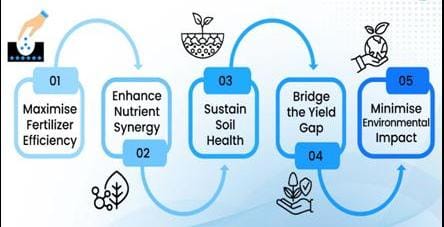
Balanced nutrient management enhances fertilizer use efficiency by maximizing nutrient uptake and minimizing losses, while fostering synergistic interactions among nutrients that support improved plant growth, crop performance, and productivity. It sustains soil fertility over the long term, including soil organic matter and biological health, helps bridge the yield gap between potential and realized crop yields through adequate nutrition, and reduces environmental impacts such as nutrient runoff, leaching, and greenhouse gas emissions arising from imbalanced fertilizer use. Regenerative agriculture is a holistic farming approach centred on restoring soil health and enhancing biodiversity. Its core practices include reducing soil disturbance, promoting crop rotation, cultivating cover crops, and integrating agroforestry systems.
By improving soil structure and increasing organic matter content, regenerative practices enhance the soil’s capacity to retain nutrients and moisture, thereby improving nutrient uptake by crops. This leads to reduced nutrient losses, lower need for repeated fertilizer applications, and more efficient nutrient use, supporting balanced fertilization. In the Indian context, widely adopted regenerative practices include micro-irrigation, precision mechanization, natural farming, cover cropping, mulching, and a climate-resilient agricultural system. Recognising the importance of balanced fertilization for improving soil health, sustaining crop productivity, and minimising environmental degradation, the Government of India has undertaken a range of proactive initiatives to promote its adoption across the agricultural sector. Launched in 2015, the Soil Health Card (SHC) Scheme provides farmers with a scientifically generated, plot-wise diagnostic report for each landholding, based on scientific soil testing. The card assesses soil health across twelve key parameters, including Macronutrients: nitrogen, phosphorus, potassium, and sulphur; Micronutrients: zinc, Iron, Copper, Manganese, and Boron; and critical soil properties such as soil reaction (pH), Electrical Conductivity (EC), and Organic Carbon (OC).

Balanced fertilization has become central to India’s strategy for sustaining agricultural productivity while addressing emerging challenges of soil degradation, nutrient imbalance, and environmental stress. Recognising the risks arising from skewed fertilizer use, the Government has undertaken proactive, coordinated measures to correct nutrient imbalances and improve fertilizer-use efficiency through science-based, farmer-centric interventions.
Initiatives such as soil test–based recommendations under the Soil Health Card Scheme, the Nutrient-Based Subsidy, promotion of Integrated Nutrient Management, encouragement of customised and fortified fertilizers, and the adoption of innovative inputs such as nano fertilizers reflect an intensive policy effort to address nutrient imbalances and improve fertilizer-use efficiency. Collectively, these interventions underscore the Government’s commitment to restoring soil health, optimising input use, and strengthening the long-term resilience and productivity of the agricultural sector.