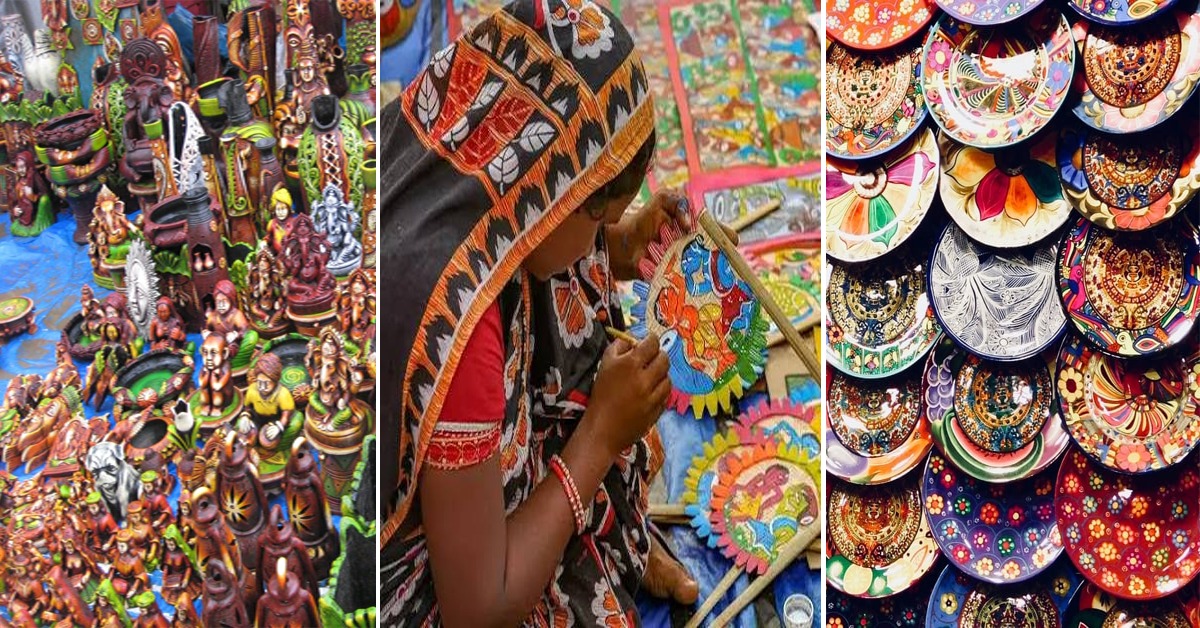
New Delhi: India’s handicraft sector plays a vital role in the country’s economy, especially in rural areas. It provides livelihoods to a large number of artisans and craftspersons across rural and semi-urban regions, contributes to exports, and helps preserve India’s rich cultural heritage. With 318 GI-tagged handicraft products and around 455 formally classified craft categories, the sector reflects the remarkable diversity of India’s creative traditions.
The Art Behind Every Handicraft
Handicrafts are goods predominantly made by hand even though some tools or machinery may also have been used in the process; such goods are graced with visual appeal; possess distinctive features, which can be aesthetic, artistic, ethnic or culturally attached and are amply different from mechanically produced goods of similar utility.
India is one of the world’s important suppliers of handicrafts; and with growing global demand for authentic, sustainable handmade products, the country is uniquely positioned to scale up its handicraft economy. A vast number of artisans across the Indian states, possess inherent skills, techniques and traditional craftsmanship, forming the backbone of the Handicrafts Industry. Even though a majority of the artisans engage in crafts work on a part-time bases with low capital investment, the value addition remains high making handicrafts a viable source of income. The sector is highly labour- intensive and decentralized, spread across the length and breadth of the country.
National Handicraft Development Programme (NHDP):
NHDP is the flagship scheme for handicraft sector promotion. It has an approved outlay of ₹837 crore for FY2022-26. During 2023-24, 2,325 projects and events were sanctioned under NHDP, benefiting 66,000+ artisans.
The scheme provides comprehensive support to handicraft clusters and artisans through basic inputs, infrastructure support, and capacity enhancement to cater to target markets. Its components are designed to offer end-to-end assistance, create a conducive environment, and ensure fair competition with machine-made products.
The focus is to bring every artisan into the mainstream while preserving traditional crafts by offering marketing platforms, infrastructure support, and design and skill training for new entrants. Along with strengthening the sector and empowering artisans, the scheme also extends social security through initiatives like Aam Admi Jeevan Jyoti Yojana and Pradhan Mantri Jeevan Jyoti Yojana, including pension support for elderly artisans.
In essence, NHDP scheme adopts the following three-pronged approach to put the sector on high growth trajectory as well as preserving existing cultural heritage:
1) Promoting premium handicraft products for the niche market.
2) Expansion of production base for utility-based, life style and mass production handicrafts products.
3) Empowerment and sustainability of artisans along with preservation and protection of heritage/ languishing crafts.
4) Empowering Artisans Through Structured Skill Development Initiatives.
More News: Bengal’s economy poised for a phenomenal leap
Today, standardized production, skilled manpower, design databases, quick & efficient prototyping, and better communication skills are essential to match the evolving production and distribution of crafts to both national and global markets.With advancements in tools & technology, the artisan’ workforce in India is evolving rapidly. To support artisans in these areas, “Skill Development in Handicraft Sector”under the NHDP has been conceptualized to fulfil these requirements and has the following four components:
1) Design and Technology Development Workshop: Focuses on meeting current market design needs by developing new designs and prototypes using the existing skills of artisans.
2) Guru Shishya HastshilpPrashikshan Program: Aims to transfer traditional craft knowledge from master crafts persons to new artisans through technical and soft-skill training, helping bridge the skill gap and create a trained workforce for market needs.
3) Comprehensive Skill Upgradation Program: Bridges skill gaps by reviving traditional crafts through National Skills Qualifications Framework (NSQF) training, enabling skill upgradation, design innovation and artisan skills.
4) Improved Toolkit Distribution Program: Provides improved toolkits to artisans to enhance productivity, ensure uniform quality, and support larger-scale production in the handicraft sector.