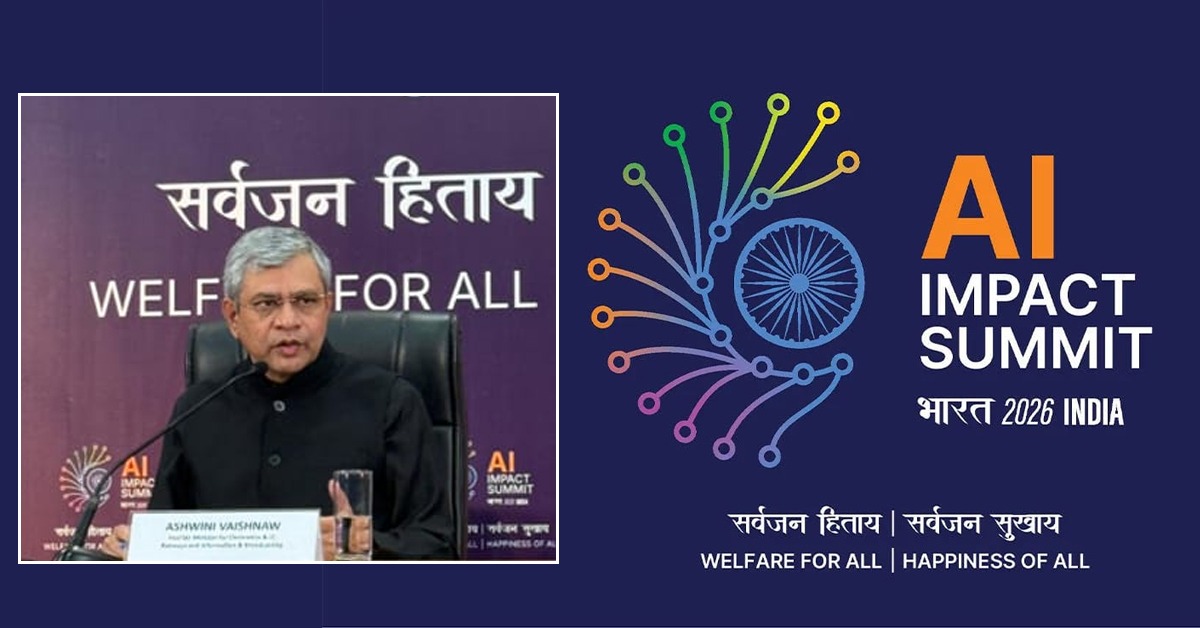
New Delhi: India is preparing to take a decisive and confident leap in artificial intelligence. During the India AI Impact Summit 2026 held in New Delhi from 16 to 20 February, Union Minister for Electronics and Information Technology Ashwini Vaishnaw announced that India will expand its compute capacity beyond the existing 38,000 Graphics Processing Units (GPUs), with an additional 20,000 GPUs to be added in the coming weeks. The announcement was not merely technical. It was strategic. It signalled that India is scaling up with intent and positioning itself firmly among the world’s leading AI powers. The models launched here have been rigorously tested against global benchmarks. When compared with leading international systems, many Indian models have been rated better across multiple parameters. This is not incremental progress. It is competitive excellence. It reinforces India’s emergence as a serious global AI player with original capabilities.
Global recognition adds further weight. Stanford has ranked India among the top three AI nations in the world. India is increasingly seen as a hub where talent, policy and infrastructure converge. The expansion from 38,000 to more than 58,000 GPUs strengthens that foundation and sends a clear message. India is building for leadership.
At the heart of this leadership is democratisation. Democratisation of AI means more than access to finished applications. It includes access to compute power, datasets and model ecosystems. When these foundational resources are available at scale and at affordable costs, innovation flourishes. Startups can experiment boldly. Researchers can test ambitious ideas. Public institutions can deploy AI solutions that reach millions. Infrastructure becomes empowerment.
The Summit’s intellectual framework rests on three foundational Sutras. The first is People, affirming that AI must serve humanity in all its diversity while preserving dignity and inclusivity. The second is Planet, ensuring that innovation aligns with environmental stewardship and sustainability. The third is Progress, emphasising that AI’s benefits must be equitably shared across societies. Together, these principles blend ambition with responsibility.
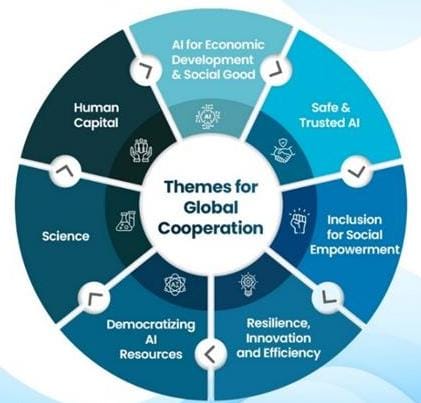
Building on these Sutras, deliberations are structured around seven Chakras that translate philosophy into action. The Human Capital Chakra focuses on building an equitable AI reskilling ecosystem and preparing the workforce for the AI economy. The Inclusion for Social Empowerment Chakra explores shared AI solutions that strengthen last mile service delivery. These discussions are pragmatic and forward looking. The Safe and Trusted AI Chakra concentrates on translating global principles into interoperable governance frameworks, strengthening domestic oversight while enabling innovation. The Resilience, Innovation and Efficiency Chakra addresses the environmental and resource challenges posed by large scale AI systems, ensuring that growth remains sustainable. These are not peripheral concerns. They are central to long term leadership. The Science Chakra aims to harness AI to accelerate discovery in health, agriculture and climate while correcting inequities in access to research capacity. The Democratizing AI Resources Chakra envisions equitable participation in global AI value chains. The AI for Economic Growth and Social Good Chakra identifies high impact use cases that can transform economies and communities. Each Chakra reflects India’s determination to link AI with measurable outcomes. This commitment to outcomes was reflected in a major announcement at the Summit. The Government of India launched 6 sectoral AI Impact Casebooks that together showcase over 170 deployed and scalable AI innovations across priority sectors including Health, Energy, Gender Empowerment, Education, Agriculture and Accessibility. These casebooks do not present prototypes or pilot ideas. They document solutions already delivering results, offering a repository of tested models that can be replicated and scaled. The momentum did not stop at documentation. The spirit of implementation carried forward into the Summit’s high impact panel discussions, where principles and proven models were interrogated, refined and aligned with sector specific realities. RailTel Corporation of India Ltd curated two sessions on AI powered public health, focusing on collaborative models for inclusive healthcare for Bharat and beyond, as well as accessible and universal healthcare delivery. Experts examined how AI can strengthen public health systems and enhance reach across diverse regions.