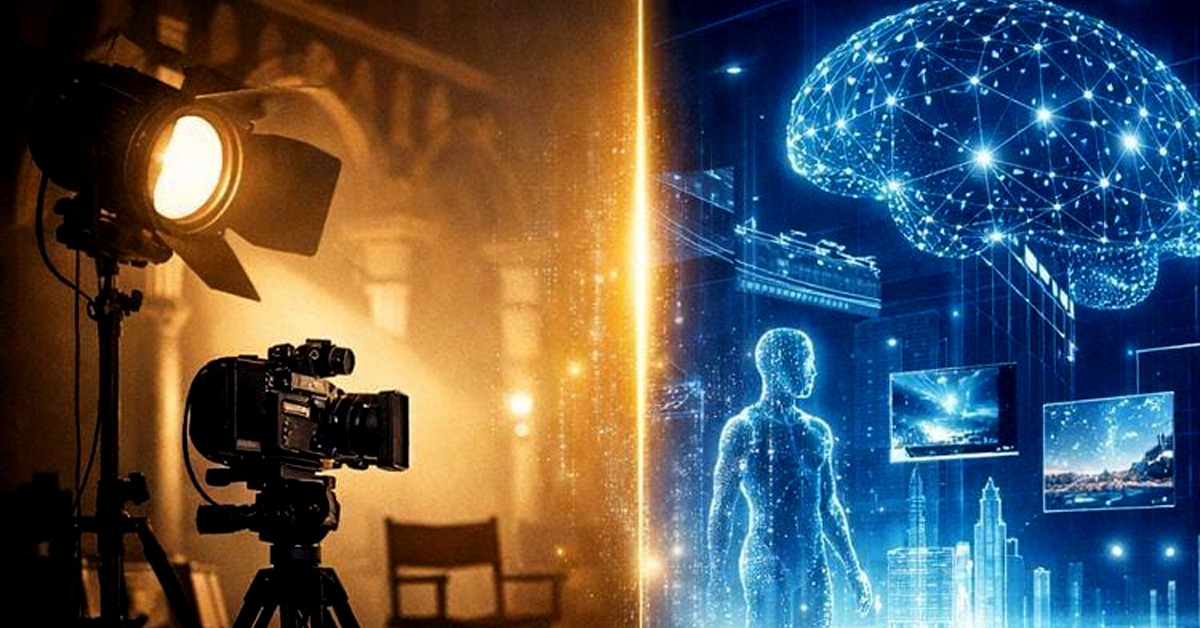
New Delhi: In the halls of Bharat Mandapam, at the India AI Impact Summit, the conversation around artificial intelligence moved beyond algorithms and computing power. It entered the territory of art. Filmmakers, writers, technologists and policymakers found themselves circling a question that felt both urgent and intimate: if machines can now write scenes, design frames and predict audience reactions, what remains uniquely human in cinema?
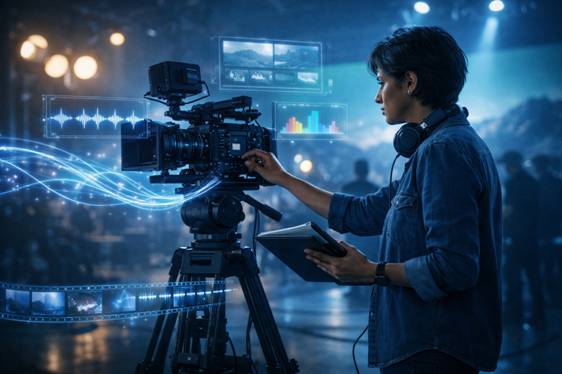
The debate was not framed in alarmist tones. Yet beneath the excitement around generative tools and intelligent systems lay a quieter concern. Cinema has always been more than production efficiency. It is memory, risk, identity and lived experience translated into moving images. When AI begins to participate in that process, the question is no longer about automation. It is about authorship.
What is unfolding is not a contest between human creativity and machine intelligence. It is a transition in how cinema is made. Artificial intelligence is beginning to handle breakdowns, visualisation, edits and data-driven insights, changing the pace and structure of production. Yet storytelling itself still draws from memory, culture and lived experience — qualities that technology can assist, but not originate. The conversation at the Summit reflected this evolving balance: not fear of disappearance, but curiosity about how authorship, scale and creative responsibility will be reshaped in the years ahead.
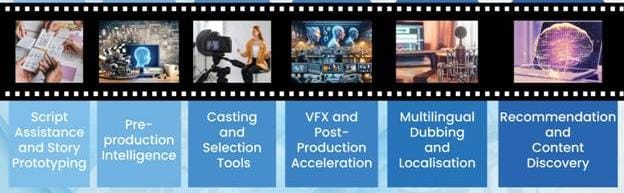
Cinema has always grown with technology, and almost every leap has arrived with doubt. Sound was once seen as the end of silent-era artistry. Colour was dismissed as spectacle. Digital cameras were criticised for lacking texture. Streaming platforms were predicted to weaken theatres permanently. Yet each shift expanded the grammar of storytelling. Creators adapted. The medium evolved. Artificial intelligence marks the next inflection point. Unlike earlier transitions that changed format or distribution, AI is entering the creative workflow itself. Its strongest impact today lies in tasks that are repetitive, time-intensive or technically complex. Industry analysis suggests that generative AI can influence multiple stages of film and television production, particularly in pre-production and post-production, where it enhances efficiency and supports creative decision-making.
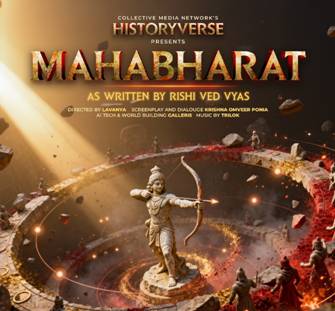
India’s epic Mahabharat was brought to life once again— this time with the support of advanced AI tools. In a collaboration between Prasar Bharati and Collective Media Network, intelligent technologies were used to enhance visuals, recreate large-scale battle scenes and add depth to characters, while keeping the spirit of the original story intact. The series first premiered on WAVES OTT and was later telecast on Doordarshan, showing how technology was used not to replace tradition, but to present it in a form that speaks to today’s audiences. There is also a structural shift underway. As high-resolution cameras, content software and AI-enabled tools become more widely available, advanced production capabilities are no longer confined to major studios. AI-assisted planning and visualisation tools lower entry barriers and enable independent creators to experiment and compete at higher levels. The reinvention, therefore, is not about replacing the storyteller. It is about transforming the infrastructure that surrounds storytelling.
For India, the conversation around artificial intelligence in cinema is not unfolding in isolation. It sits within a larger transformation of the country’s creative economy. India is one of the world’s largest producers of films, with a multilingual ecosystem that spans regional industries, streaming platforms and global audiences. As storytelling scales across languages and formats, technology becomes not just an enabler, but infrastructure.
Artificial intelligence can write a scene in seconds. It can compose background music, generate faces, recreate voices and build entire visual worlds from prompts. It can analyse thousands of scripts and tell us what usually works. But cinema has never been about what usually works. It has been about a director choosing an ending that feels right, even if it defies expectation. About an actor allowing a moment of silence to carry more meaning than dialogue. About a writer drawing from memory, emotion and lived experience, not just pattern recognition. AI can generate possibilities. Humans decide which ones are worth keeping. Machines recombine patterns from the past. Artists take risks for the future.
The real concern, then, is not that creativity will disappear. It is that it could become predictable. If stories are shaped only by algorithms trained on past successes, the result may be efficient but emotionally thin. Cinema endures because it surprises, because it unsettles, because it lingers long after the screen goes dark. At the same time, the opportunity is undeniable. AI can remove friction from the creative process. It can shorten production cycles, simplify technical barriers and make sophisticated tools accessible to independent creators. A filmmaker without access to a major studio can now visualise ambitious scenes. A regional story can reach new audiences through intelligent localisation. That is not replacement. It is amplification. The question, therefore, is not whether India should resist AI. It is how Indian cinema will shape it. How storytellers embed intention into intelligent systems. How directors, writers and animators ensure that technology strengthens, rather than standardises, creative expression.
The future of Indian cinema will not be defined by resisting artificial intelligence. It will be defined by embedding human vision into intelligent systems. Because when the lights dim and the first frame appears, what moves an audience is not computation. It is connection.