
New Delhi: India’s statistical system is undergoing a comprehensive modernization to better capture the realities of a fast-changing economy. Over the decade since the last base year (2011-12), the country has seen significant structural shifts, the services sector has expanded rapidly, formalization has increased under the Goods and Services Tax (GST), and digital platforms have transformed business models. These changes created demand for more timely indicators, finer geographic detail, and improved coverage of the informal and services sectors. In response, the Government has initiated coordinated reforms as part of a broader modernization of the national statistical system aimed at strengthening data quality, credibility and policy relevance.
Major reforms under this include the upcoming revision of GDP and price indices base years, improvements in measuring the informal and services economy, enhancements to labour market statistics, cross-cutting innovations in survey methods and technology, and steps to boost transparency through stakeholder engagement. Together, these reforms are poised to improve the timeliness, granularity and trustworthiness of India’s official statistics for evidence-based policymaking.
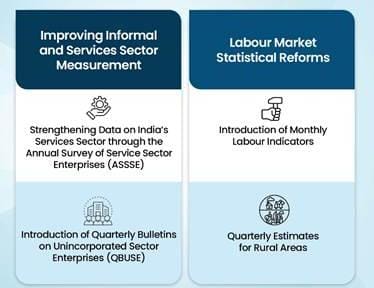
Periodic base year updates ensure that GDP and other indices reflect the current economic structure and relative prices, which tend to evolve over time. The base year is revised periodically to better capture the structural changes happening in the economy by updating the methodology of compilation and incorporation of new data sources.
Moreover, rebasing allows adoption of international best practices in methodology as recommended by bodies like the UN Statistical Commission. Aligning with updated global standards ensures that India’s statistics remain comparable and methodologically sound in light of new guidance on measuring the digital economy, supply-use tables, etc.
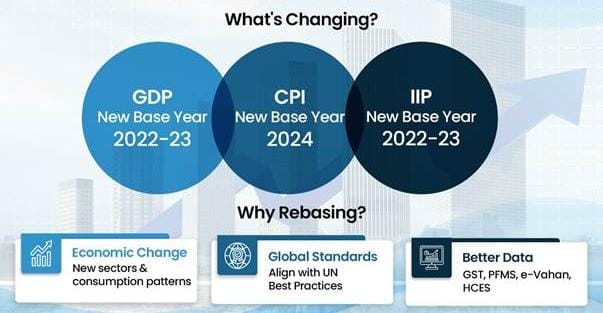
One of the major reforms has been the revision of the base year for Gross Domestic Product (GDP) estimates, from 2011-12 to 2022-23. In the decade since 2011-12, India’s economy has transformed drastically, with new industries emerging (e.g. renewable energy, digital services) and changes in consumption patterns and investment behaviour. Such structural changes necessitate rebasing so that metrics like GDP capture true contribution of growing sectors and changes in technology and productivity.
Over the years extensive digitization has also opened up new data sources and incorporating these data into national accounts will improve accuracy and detail. For instance, real-time administrative databases like e-Vahan (vehicle registrations), the Public Financial Management System (PFMS), and the GST system now provide granular economic data.
The recent statistical reforms mark a decisive shift in India’s statistical system towards greater relevance, responsiveness, and credibility. By updating base years for GDP, CPI, and IIP, strengthening measurement of the informal and services sectors, and transforming labour statistics, the Government has aligned official data more closely with the structure and dynamics of today’s economy.
At the same time, various measures have been undertaken to significantly improve data quality, timeliness, and public access. The coordinated rollout of new series and systems reflects a commitment not only to methodological rigor and international best practices, but also to transparency and stakeholder engagement.
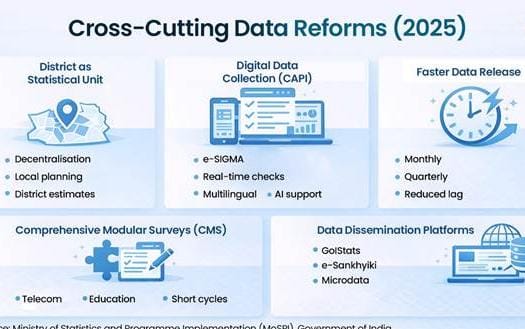
These initiatives lay a stronger statistical foundation for evidence-based policymaking, effective decentralised planning, and informed public discourse, ensuring that India’s official statistics remain fit for purpose in a rapidly evolving economic landscape.