
Writer, Social Worker
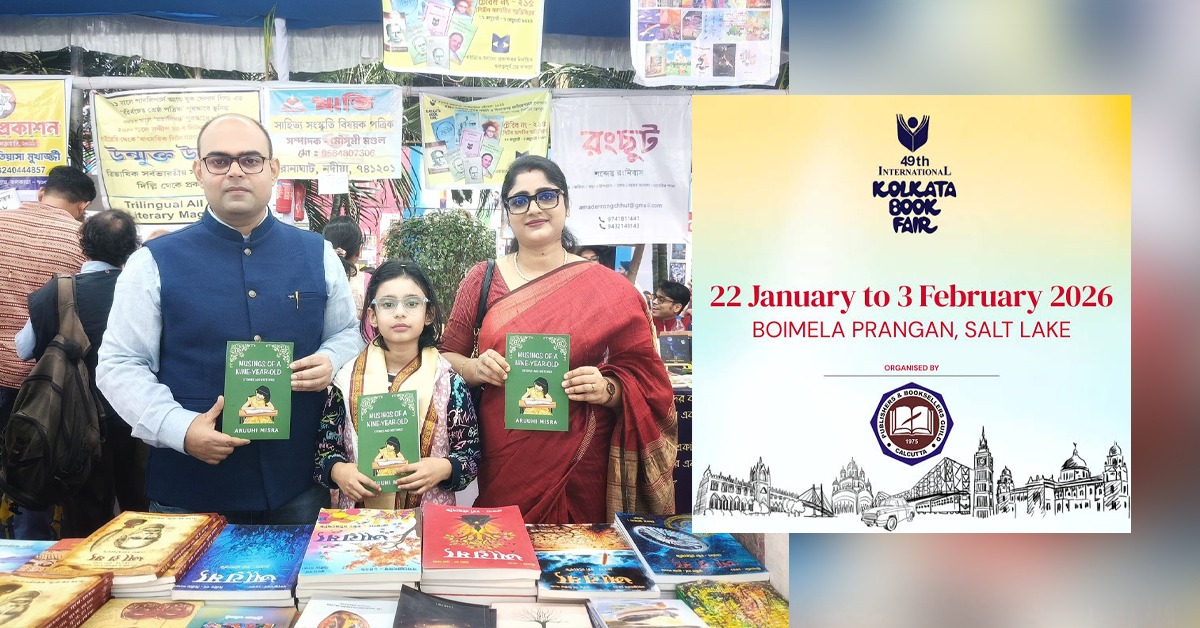
On a winter afternoon in Kolkata, amid the hum of voices, the rustle of pages, and the familiar scent of fresh books, a small table at the Little Magazine Pavilion becomes the centre of quiet excitement. Table No. 202, entered from Gate No. 9, holds more than just books stacked neatly in rows. It holds the story of a child whose journey with words began almost as soon as she learned how to shape them. On 25 January 2026, at five in the evening, readers gather not merely to witness a book launch, but to celebrate a young mind that has already discovered the power of imagination, discipline, and storytelling. The book being launched is titled Musings of a Nine-Year-Old: Stories and Histories, and the author, Aruuhi Misra, is just nine years old.
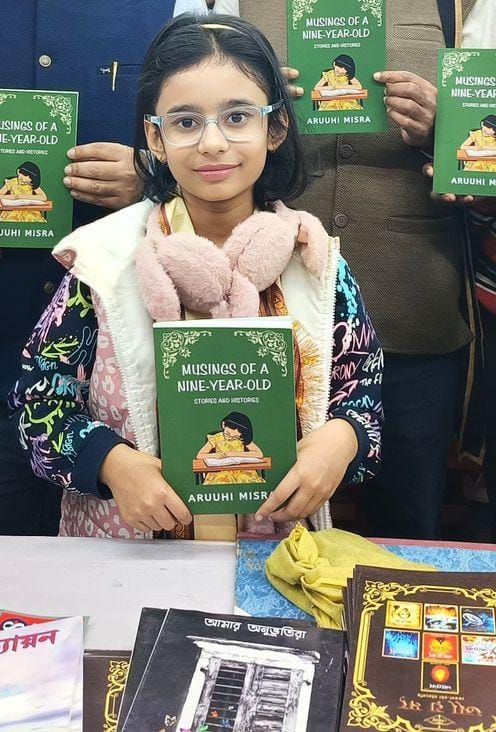
Aruuhi is often described as the youngest author of West Bengal, but such labels barely capture the essence of her story. Long before she became a name on book covers or a subject of conversation at literary gatherings, she was simply a child fascinated by books. Her relationship with writing did not begin with ambition or planning. It began with wonder. When she was only four or five years old, her father’s first book was published. The memory of holding that book remains vivid for her. The weight of it in her hands, the printed words, and the idea that thoughts could be preserved and shared made a deep impression. In that quiet moment, she felt something stir within her—a simple but powerful thought that she too wanted to write a book.
She began in the most natural way possible. There were no grand plans, no pressure to perform. She wrote paragraphs—small pieces of thought and imagination. Slowly, those paragraphs turned into short stories. Writing felt less like work and more like play, a way to explore ideas and emotions. Stories flowed from her curiosity, shaped by what she read and what she observed around her. Writing was not something she had to be told to do; it was something she wanted to do.
By the time Aruuhi was in Class II, her stories took the form of a book. Seeing her name printed on the cover was a moment of unfiltered joy. She remembers that happiness clearly, a feeling that knew no bounds. For a child so young, it was not just an achievement; it was validation of something she had felt instinctively—that her ideas mattered and could live beyond the pages of her notebook.
Her first book, an anthology of short stories, struck a chord with young readers. Children saw themselves in her words, in the simplicity and honesty of her storytelling. The response was overwhelming. The book did not merely sell; it connected. It became so popular that it was published multiple times, eventually reaching its fourth publication, with several reprints across editions. Few authors, regardless of age, experience such a reception so early in their journey.
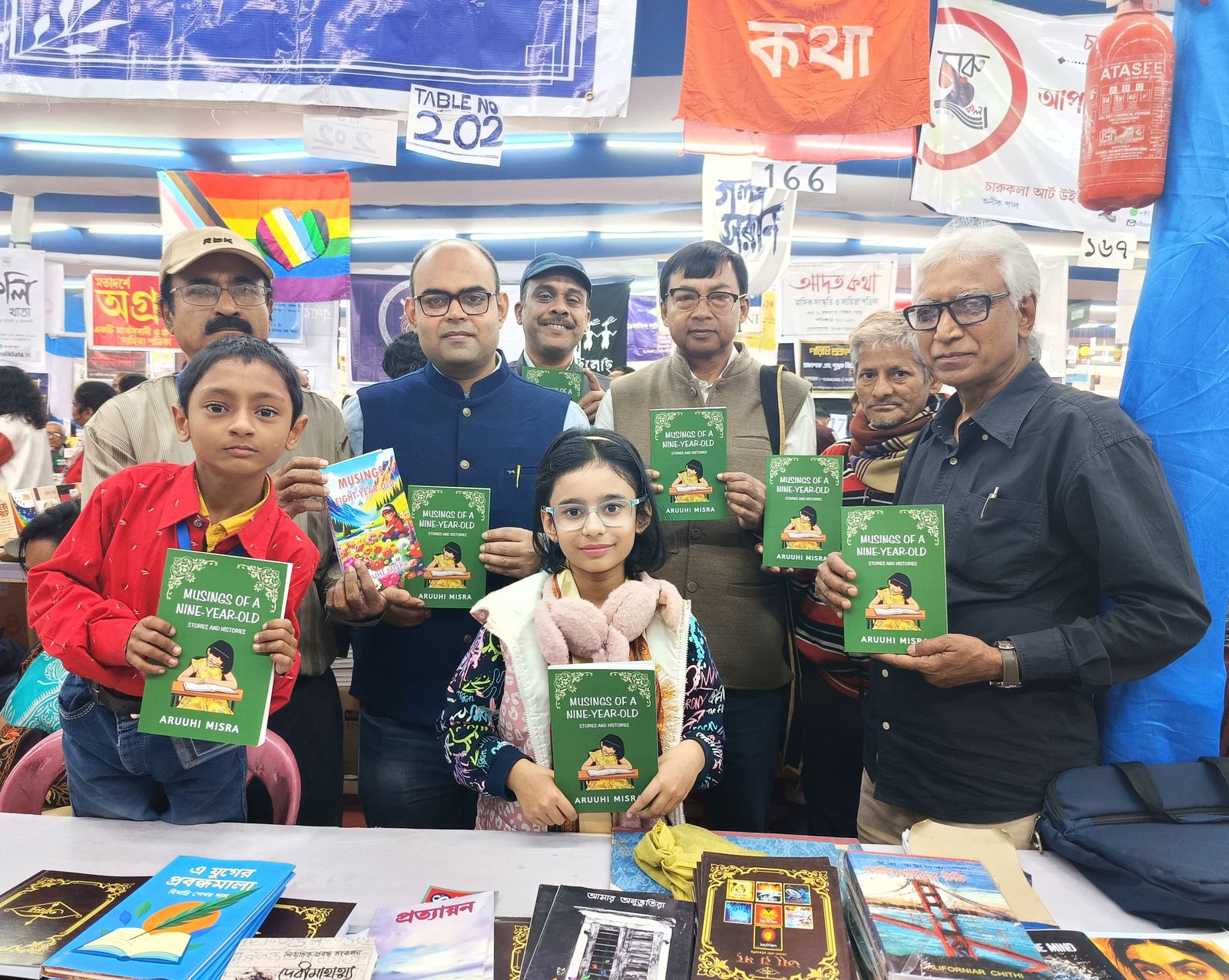
Now nine years old, Aruuhi returns with her second book, Musings of a Nine-Year-Old: Stories and Histories. This book reflects both continuity and growth. It carries forward her love for storytelling while introducing a new dimension to her writing—History. The book includes imaginative short stories alongside historical narratives shaped by a child’s understanding of the past. It is not a textbook retelling of events, but an exploration driven by curiosity, reading, and interpretation.
Her interest in History grew naturally. During a visit to the Kolkata Book Fair the previous year, Aruuhi found herself drawn to books on early humans and ancient civilizations. She was fascinated by how people lived long ago, how societies formed, and how human life evolved. When she was promoted to Class III and discovered that Early Humans was part of her school syllabus, the connection felt almost magical. Reading and learning merged seamlessly with her imagination.
She wanted to write about early humans, and although that particular story does not appear in this book, it marked the beginning of a deeper engagement with History. She began reading more historical books, slowly developing her understanding. She wrote stories inspired by what she read, blending facts with imagination, always mindful of staying true to what she had learned. Initially, she planned to write an entire book on History, but her parents encouraged her to read more before doing so. They wanted her knowledge to grow richer and her understanding deeper. Aruuhi accepted their guidance, and the result is a book that contains five historical stories, each reflecting her evolving perspective.
Kolkata’s Timeless Architecture, Framed One Month at a Time
Despite her achievements, Aruuhi remains refreshingly unaffected by labels. She knows that people call her a writer. She has heard about authorship, mostly from her father. It makes her feel good, but she does not overthink it. What she understands clearly is her love for reading and writing. Writing, for her, is not a status or a goal; it is an expression of joy. She writes because she loves to put her ideas on paper.
She openly admits that praise makes her happy, but it is not the reason she writes. What truly excites her is reading storybooks and the thrill of starting a new story. Books are her constant companions. They inspire her, teach her, and quietly shape her thoughts. When ideas come to her, she feels an urge to write them down before they slip away.
When asked what advice she would give to other children who want to write, her response is simple and sincere. She believes that reading is essential. One must read and read, she says, because books help ideas grow naturally. When those ideas begin to form, they should be written down. Inspiration can come from books, from people, or from everyday life. But above all, one must write. Not wait for perfection. Just write.

Aruuhi’s creative life is not limited to writing alone. She is also a singer, with several music videos to her name. Music offers her another way to express herself, another language through which emotions flow. Whether she is singing or writing, the intent remains the same—to express what she feels and imagines.She studies at South Point School, where she balances her creative pursuits with academics. Interestingly, her favourite subjects are Mathematics and Science. Numbers, logic, and scientific concepts fascinate her as much as stories do. Her dream is to become a doctor one day, a goal that reflects her curiosity about life and her desire to help others. To her, creativity and science are not opposites; they are complementary ways of understanding the world.
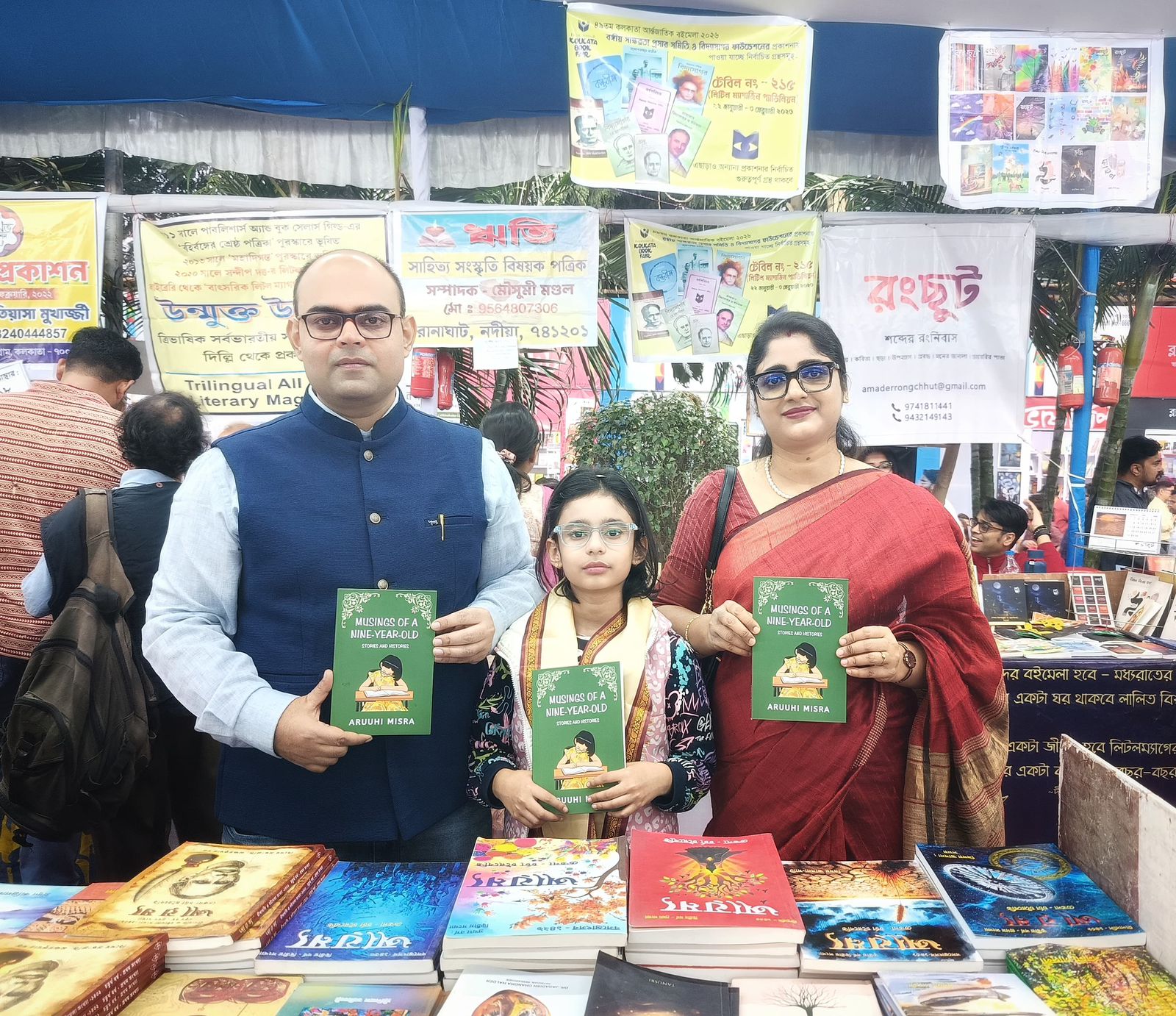
Behind Aruuhi’s journey is a family that supports without imposing. Her father’s example introduced her to the world of books, while her parents guide her gently, ensuring that her love for writing remains joyful rather than burdensome. They encourage her to read more, learn more, and grow naturally into her interests.Her achievements have not gone unnoticed. Aruuhi has been nominated in the author category for the Pradhan Mantri Rashtriya Bal Puraskar 2025, India’s highest civilian award for children. The nomination was recommended by Shri Tridib Chatterjee, adding significant recognition to her young literary journey. Yet, Aruuhi herself remains humble and somewhat puzzled by the attention. She often says she does not understand why people bless her or shower her with love. She writes because she loves to, without expecting anything in return. Aruuhi writes on paper. She prefers pen and page to screens, forming each word carefully. There is something deliberate and thoughtful in the way she writes, as if each sentence deserves attention. In a fast-paced digital world, her approach feels almost timeless.“I finish my studies first and then I write. Studying helps me learn new things, and those things help me write better,” Aruuhi says.
As the book launch unfolds at the Little Magazine Pavilion, readers young and old gather around Table No. 202. They flip through pages, exchange smiles, and wait patiently to meet the young author. For many, it is inspiring to see a child so deeply connected to books—not as an obligation, but as a joy.
Aruuhi’s story is not just about early success. It is about curiosity nurtured, creativity respected, and childhood preserved even as talent blooms. Her journey reminds us that stories do not need age or authority to be meaningful. They only need honesty, imagination, and the courage to be written.
“We never asked Aruuhi to become a writer. We only encouraged her to read, remain curious, and enjoy whatever she chooses to do. Writing came naturally to her, and our role has always been to let her stay a child while her imagination grows,” say her proud parents, Ssunny S. Misra and Manissha Sunyy Misra. Her story is still unfolding. There are books yet to be read, histories yet to be explored, songs yet to be sung, and dreams yet to be fully understood. For now, she continues to read, to write, and to dream, filling pages with ideas and possibilities. And perhaps that is the most beautiful part of her journey—the knowledge that this is only the beginning.